
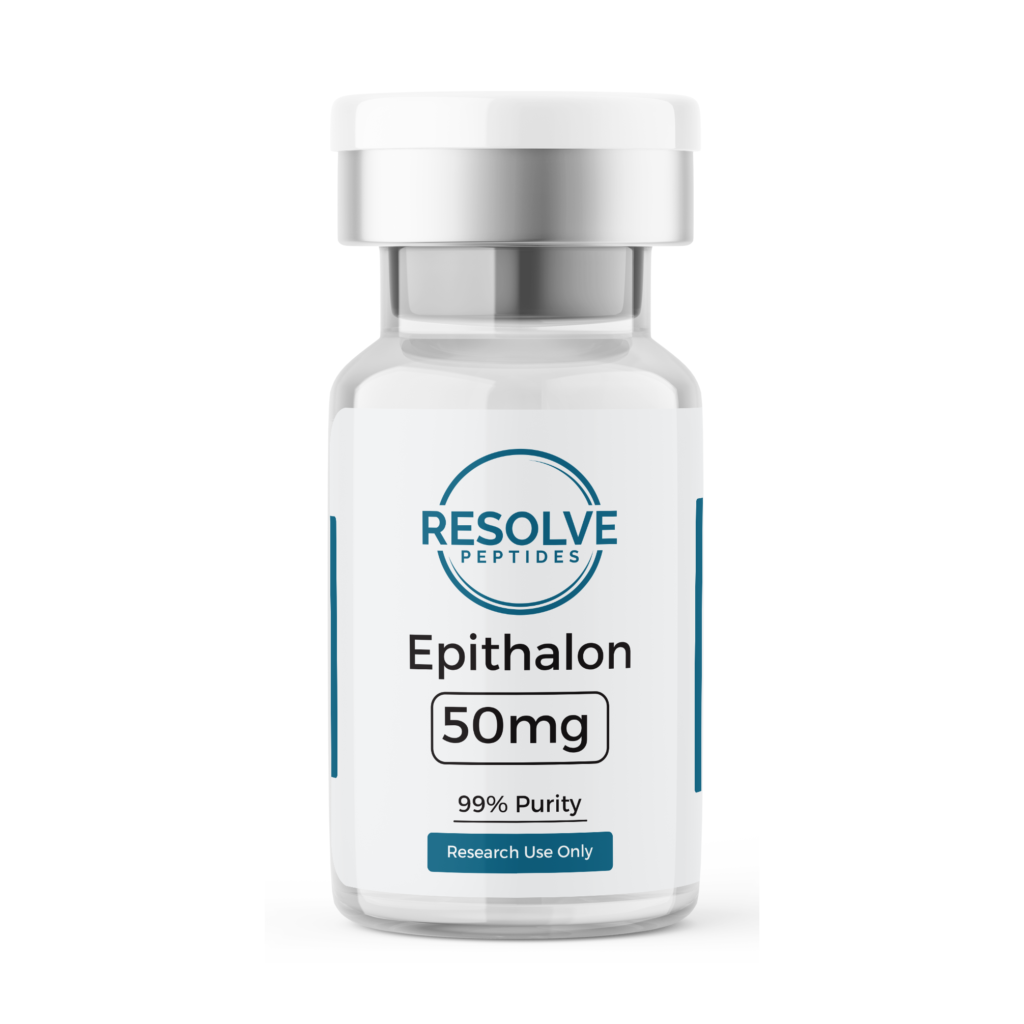
Description
What is Epithalon?
Epithalon (also referred to as Epitalon, Epithalone, or Epithalamin) is a synthetic short peptide composed of four amino acids. It is widely recognized for its ability to stimulate telomerase activity and influence melatonin secretion. Originally developed in Russia during the 1980s, Epithalon has been studied for its potential to delay age-associated changes in the reproductive and immune systems, while extending lifespan in animal models such as mice and rats.
Although primarily investigated in the context of longevity and anti-aging research, Epithalon has also shown promise in areas relating to DNA protection, cancer biology, immune modulation, and infectious disease studies.
Epithalon Structure
-
Sequence: Ala-Glu-Asp-Gly
-
Molecular Formula: C14H22N4O9
-
Molecular Weight: 390.35 g/mol
-
PubChem CID: 219042
-
CAS Number: 307297-39-8

Figure 1. Epithalon skeletal structure and molecular profile — resolvepeptides.com
Research Areas
1. Telomerase Activation and Longevity
Preclinical studies in insects and rodents demonstrate that Epithalon significantly extends lifespan, in some cases reducing mortality rates by more than 50%. Its antioxidant activity and ability to activate telomerase are believed to be central to these effects. Telomerase protects and restores telomeres, the DNA sequences at the ends of chromosomes that degrade with aging. By preserving telomere length, Epithalon has been shown to reduce DNA errors and protect against age-related cellular decline.
2. Epithalon and Gene Expression
Beyond its effects on oxidative stress and telomeres, Epithalon has been shown to interact directly with gene promoter regions, influencing the expression of multiple genes involved in immune regulation (CD5, IL-2), connective tissue repair (MMP2, Tram1), and melatonin synthesis (AANAT, pCREB). This suggests a possible role in immune resilience, tissue recovery, and circadian rhythm regulation.
3. Skin Health and Tissue Repair
Epithalon has been shown to stimulate fibroblast activity and regulate MMP2 expression, both of which are critical for collagen and extracellular matrix production. Animal studies report improved skin structure, accelerated wound healing, and reduced apoptotic activity, indicating its potential in dermatological and regenerative research.
4. Tumor Growth and Oncology Research
Animal models indicate Epithalon may help slow tumor progression and reduce metastasis in certain cancers. Research also suggests it may enhance sensitivity to radiation therapy by influencing PER1 gene expression, which is often dysregulated in cancer cells. This dual activity—slowing tumor growth and enhancing treatment efficacy—makes it a compound of interest in oncology studies.

5. Melatonin Regulation and Circadian Rhythm
Studies in rodents and primates show that Epithalon enhances melatonin production by activating genes such as AANAT. By restoring circadian rhythm and melatonin balance, Epithalon may support research into sleep regulation, endocrine health, and age-associated disorders.
6. Vision and Retinal Function
Animal trials have demonstrated that Epithalon can help preserve retinal integrity and improve visual outcomes in degenerative eye conditions such as retinitis pigmentosa, highlighting potential in ophthalmological research.
Future Research Directions
Epithalon continues to attract global interest as a candidate for anti-aging research, gene regulation, cancer biology, skin health, and neuroendocrine function. Its unique ability to activate telomerase and modulate multiple cellular pathways makes it a powerful tool in preclinical studies exploring healthy aging and regenerative medicine.
Disclaimer
All Epithalon offered by resolvepeptides.com is intended strictly for laboratory and scientific research purposes only. These products are not approved by the FDA, are not medicines or supplements, and are not sold for human consumption, medical treatment, or veterinary use. Any discussion of potential benefits is based solely on preclinical findings.
Referenced Citations
-
Anisimov VN, Mylnikov SV, Khavinson VK. Epithalamin increases lifespan of fruit flies, mice, and rats. Mech Ageing Dev. 1998.
-
Khavinson VK, Bondarev IE, Butyugov AA. Epithalon peptide induces telomerase activity and telomere elongation in human somatic cells. Bull Exp Biol Med. 2003.
-
Anisimov VN et al. Effect of Epitalon on biomarkers of aging, lifespan, and tumor incidence in mice. Biogerontology. 2003.
-
Khavinson VK et al. Short cell-penetrating peptides interact with gene promoter sites. Bull Exp Biol Med. 2013.
-
Linkova NS et al. Peptide regulation of skin fibroblast functions during aging. Bull Exp Biol Med. 2016.
-
Kossoy G, Anisimov VN, Zusman I. Effect of Epitalon on spontaneous carcinogenesis in mice. Vivo. 2006.
-
Gery S, Komatsu N, Koeffler HP. The circadian gene PER1 in cancer regulation. Mol Cell. 2006.
-
Korkushko OV et al. Normalizing effect of pineal peptides on melatonin rhythm in primates and humans. Adv Gerontol. 2007.
-
Khavinson V, Razumovsky M, Trofimova S. Epitalon improves retinal condition in retinitis pigmentosa. Neuro Endocrinol Lett. 2002.
Reviews
There are no reviews yet.